
Inquiry Question: How was society in pre-revolutionary France structured?
Society in France in 1789 was, for all intents and purposes, was largely the same as it had been for centuries. Change for the average person in France came very slowly and was often unnoticed. In contrast, our modern world appears to change rapidly largely due to technological innovation (e.g. the internet, smart phones, social media) and economic and cultural exchanges. However, life in 18th century France was, for the most part, the same as it had been during the middle ages. As a result, the social structure of the time was ordered the same. It is this medieval social structure, coupled with the political system of the French monarchy, that was known as the ancien régime, which still dominated France on the eve of the French Revolution in 1789. In this lesson we will examine the social structure of the ancien regime. In lesson 3 we will study the political system of the French monarchy.
The term ancien regime first appeared in 1794, five years into the French Revolution. In modern English the phrase “old regime” is used. It is interesting to note that this term has its own historical perspective, one that looks backwards to a time that is now past. The people of pre-revolutionary France would not have said “ancien regime” because they were living in it.
While you watch the video, record some notes on the following topics;
- Life in Medieval Europe for the average peasant.
- The role of the local lord and the Church in Medieval life.
Key Takeaway: Life for most people in France in the 18th century was largely unchanged from life for people during the medieval period. Wars devastated communities, famines were common, and the plague and other diseases ravaged the population. Most people were subsistence farmers, and while some owned a small piece of land, most had to pay rent to a noble or perform labour on the noble’s estate. The Church remained immensely powerful in the cultural lives of French people, authorizing marriages, educating children, and enforcing “correct” expressions of faith. In many ways, life in France in the 18th century looked very much like life in the 14th century.
The Three Estates
The social structure of France in the 18th century was referred to as the society of orders. There were three groups or classes of people and everyone, except the king, fell into one of these groups. These groups were called the three estates. These are outlined below;
- The First Estate: “Those who pray.”
- The Second Estate: “Those who fight.”
- The Third Estate: “Those who work.”
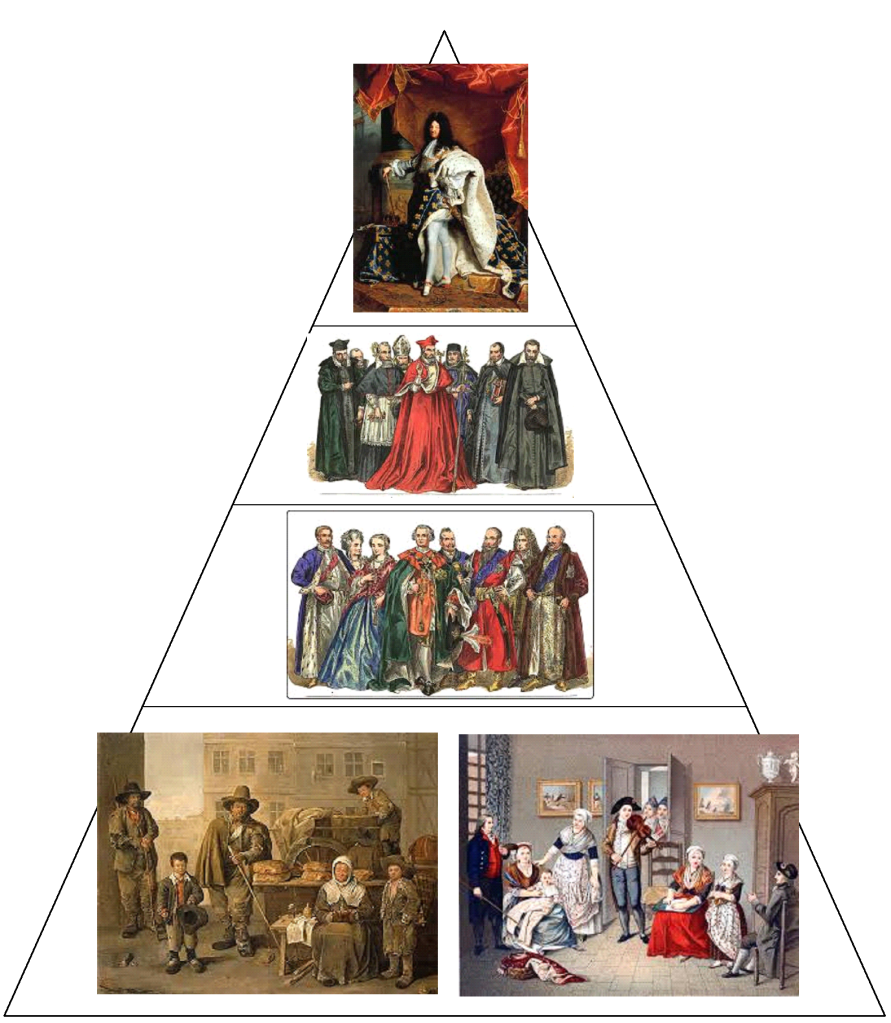
Inquiry: The Three Estates
Background: French society was separated into three groups, these were called the Three Estates. Everyone in France was a part of one of these estates. Only the King was not in one of the groups.
Global Context Exploration: Power and Privilege
Task: Your group will be assigned one of the Three Estates. As a group, research the following;
- Describe your estate.
- Identify some powers and privileges you possess. (Hint: what can you make others do (power), and what are some things you are given (privilege)?)
- Is everyone in your estate the same? Explain.
Suggested resource: Alpha History
When everyone is finished you will present what you learned about your estate to the rest of the class. Use the handout below to take notes.
Reflection
What are your thoughts on the society of orders? Does this seem like a fair system? Do you think some people deserve powers and privileges that others don’t? Submit your answers as an “exit ticket” on Managebac.
Key Terminology in this Lesson
- Ancien Regime
- Society of Orders
- The Three Estates
- First Estate
- Second Estate
- Third Estate
- Clergy
- Nobility
- Peasants
- Merchants/Bourgeois
- Power
- Privilege
 CISH Modern History