
Objective B: Investigating
i. Formulate a clear and focused research question and justify its relevance.
The first major step of the research process is to formulate a clear and focused research question, but what does that mean?
Clear: The research question must be understandable. This does not mean the question is simple, but rather the question explains itself. In other words, I should be able to understand your question without asking you to explain what it means.
Focused: Your question must be focused on a specific issue or topic in history. You will be given a list of topics for each research project, but they are broad topics. You must find something specific about the topic to research. This will require you to do background research on the topic so you have a good understanding. From there, you can find more specific sub-topics to focus on.

Think of the research question like a flashlight, but one with a very narrow beam. Your research question should focus on a specific issue or idea that is relevant to your topic. When you are doing your background research, consider what is unknown, uncertain or debatable about the topic. In the social studies, there is more that we do not know compared to what we do know. With history, the past is often obscured either by a lack of evidence or the bias of the historians who have interpreted it. Many events and topics in history may appear simple but there are often factors that are not considered or investigated. Furthermore, the motivations or causes of historical events are usually complex. Therefore, when doing your background research look for the uncertainties, question the available evidence and think about what really happened and why.
Ultimately, your research question must result in a detailed, thoughtful and complex answer. If your research question can be answered in only a few words then it is not good enough. If your research question has a simple answer then it is likely you have not formulated an appropriate question.
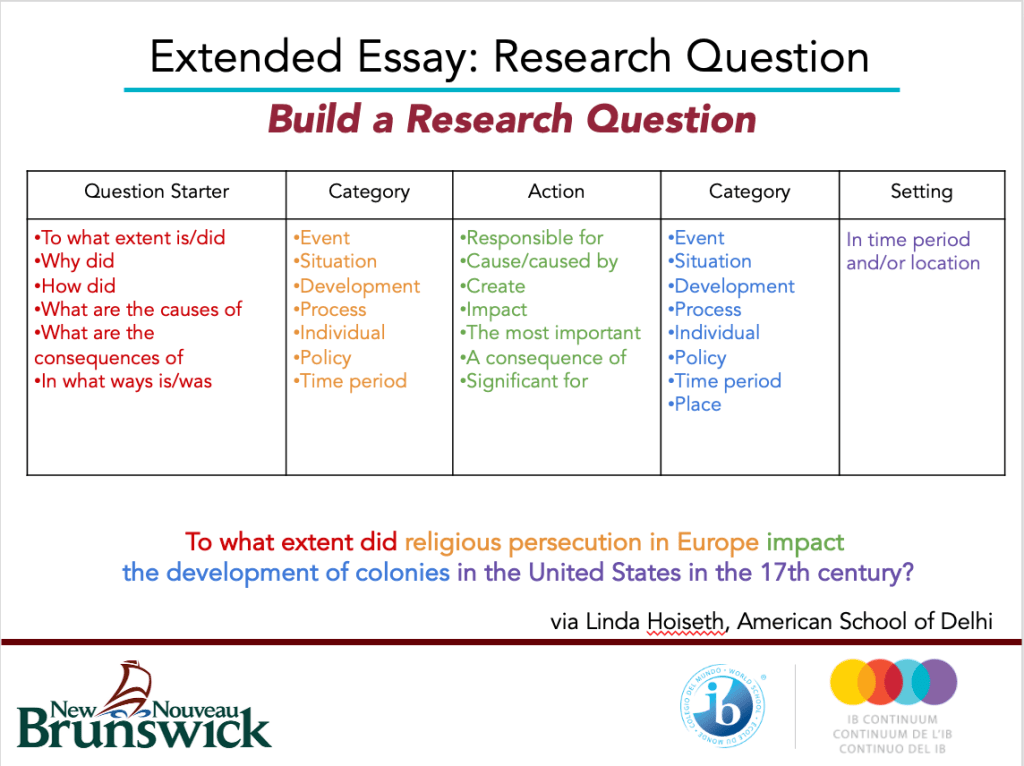
Below are a list of okay and better research questions. Do you know why they are good and bad?
Okay examples:
- Who was Abraham Lincoln?
- What did Napoleon do?
- Why did WWI happen?
- What happened after the Cold War?
- Why did Stalin do the Great Purge?
Better examples:
- Why, despite centuries of relative stability, did the Roman Empire collapse in the 6th century CE?
- To what extent did the Enlightenment change popular attitudes toward government in the 18th century?
- Why did the Crusades ultimately fail to successfully conquer and occupy the Holy Land?
- Why did the United States eventually declare war on Germany in 1917 after years of neutrality during the First World War?
- Was conflict between the Soviet Union and the United States inevitable?
- To what extent was Germany truly responsible for causing the First World War?
In summary… a good research question should be;
- interesting: personally and intellectually
- valuable: shouldn’t just repeat what everyone knows, leads to a new perspective or creation of new knowledge
- useful: helpful to direct the scope and direction of research – helps you find information and not waste your time
Justifying the Relevance of the Research Question
For every topic there are countless questions that could be asked, so why did you choose the one you did? This is an essential step in the research process, as all research must have a purpose. We do not research things for no reason! So, why are you researching this question?
In addition to formulating a clear and focused research question, you need to justify its relevance. In order to do this you must identify a connection to a bigger concept or idea, like the statement of inquiry, global context, key concept, or a related concept. You must justify this connection with appropriate evidence. This requires you to have some knowledge of your topic.
To accomplish this task it is important to carefully consider the historical background of the topic and you are encouraged to do some preliminary research to get some understanding of the topic.
In summary… you need to justify how your research question is connected to either…
- The key concept: change
- The global context: fairness and development
- The related concept: equity, power, causality (cause and consequence)
- The statement of inquiry: “Students will understand that individuals are motivated by ideas of fairness to demand political change and to create a more equitable society.”
 CISH Modern History