
Source: Bundesarchiv, Bild 102-14469 / CC-BY-SA 3.0, CC BY-SA 3.0 DE https://creativecommons.org/licenses/by-sa/3.0/de/deed.en, via Wikimedia Commons
Inquiry Question: Why did the Nazis exclude Jews from cultural and political life in Germany between 1933 and 1939?
The years of 1933-1939 saw a gradual erosion and, ultimately, elimination of the cultural, social, and legal rights of Germany’s Jewish community. There two faces to this process. Firstly, the Nazis cultivated the idea of pure “Aryan” German blood and made this the foundation of their new “national community”. Secondly, the Nazis identified individuals and groups who were genetically deficient or inferior that must be excluded from the national community because they were belived to be dangerous.
The Nazis were quick to act against their imagined enemies within German society, organizing a boycott of Jewish shops and businesses in 1933. Race laws were implemented in 1935 which legally defined who could be recognized as a German citizen. A euthinzation program, blandly titled the T4 Program, was established to kill people with perceived mental illnesses (e.g. Downs Syndrome, Aspergers). Political opponents, homosexuals, Roma, and other “inferior peoples” were sent to concentration camps. The ultimate goal here was the “purification” of the German nation.
In this lesson we will examine a series of primary sources to try to understand why this happened. How could something we believe to be cruel and inhuman today be tolerated by a population of ~70,000,000 people?
Viewing Question: “How did Nazi Germany gradually (slowly over time) limit the rights and freedoms of Jews and persecute other perceived enemies of the state between 1933 and 1939?”
Interpreting Primary Sources: Antisemitism in Nazi Germany
Source A: Mein Kampf (1925)
Mein Kampf was written by Adolf Hitler during his prison sentence in Landsberg Prison in 1925. It lays out Hitler’s ideological views and his ideas on antisemitism. A brief selection of his book is listed below. While you read, consider the following questions;
- Identify Hitler’s reasons for hating Jewish people.
- Summarize Hitler’s ideas in the second quotation. How might this be connected to genocide?
Source B: National Socialist German Catechism
The following document was part of an instructional book used in schools throughout Nazi Germany. The book included the views of the Nazi Party on a variety of topics. A catechism is method of teaching belief or ideology, usually in the form of questions and answers that must be memorized.
The text below is from the section on “race”. It gives us a good idea of what the Nazis believed about race and how it was important to their view on German identity.
Instructions: Read the following source with a partner. While you read, take notes on;
- What the Nazis believed about race and identity.
- What this source reveals about Nazi antisemitism.
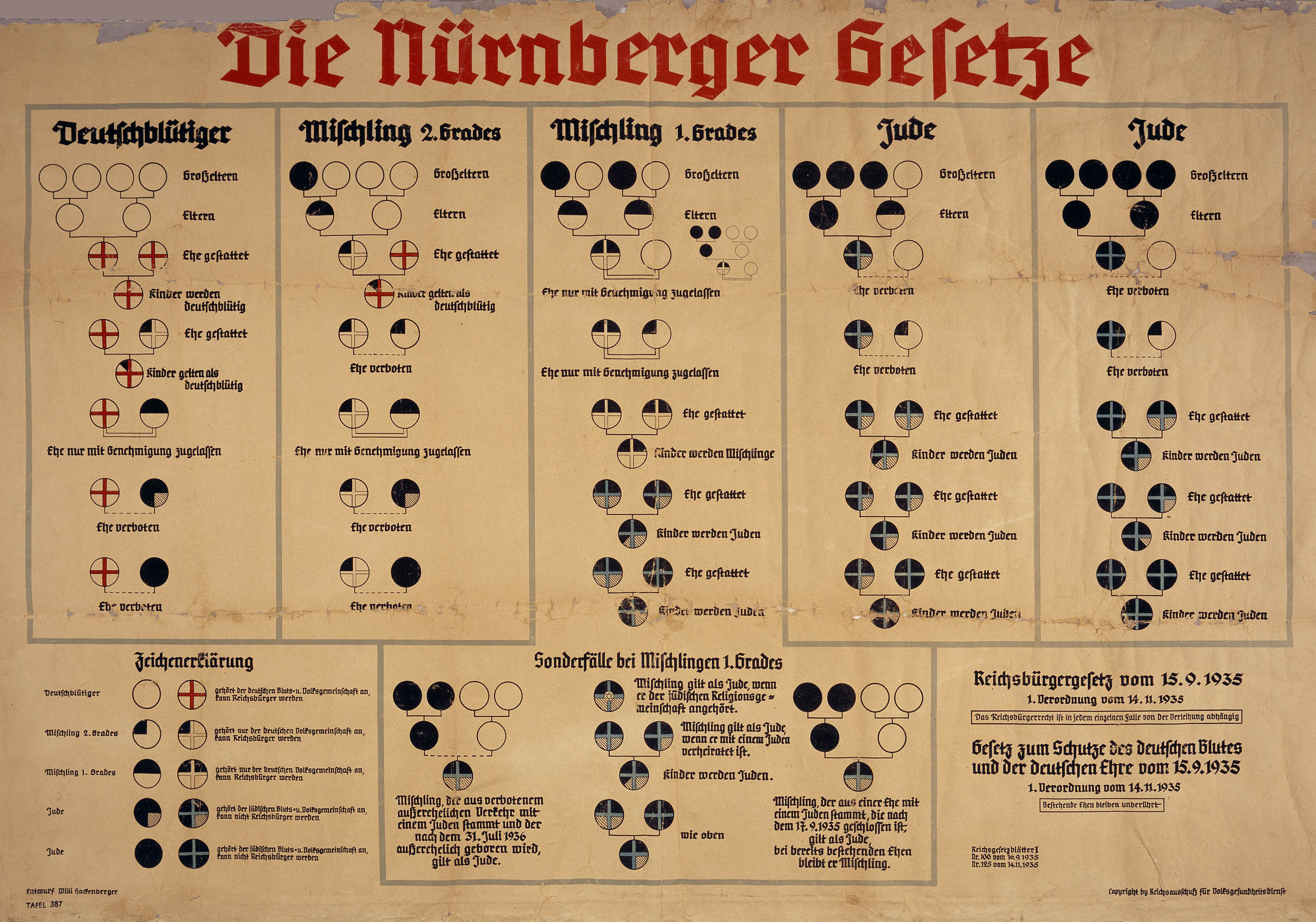
Source C: The Nuremberg Laws (1935)
In 1935 the Nazis passed a series of laws in the German Reichstag (parliament) with the intention of excluding Jews from German society. Together, these laws are known as the Nuremberg Laws because they were initially announced at a Nazi Party rally in the German town of Nuremberg.
- What was the stated purpose of the Nuremberg Laws?
- What did the Nuremberg Laws do to achieve this purpose?
Source D: Kristallnacht (1938)
On November 9th and 10th, 1938, members of the SA, SS and Hitler Youth destroyed Jewish businesses, set fire to synagogues, and assaulted Jews on the streets. In addition, 30,000 Jews were arrested and sent to concentration camps. In total, at least 91 Jews were killed, around 300 synagogues were destroyed, and 7,000 businesses damaged and vandalized. Historians consider Kristallnacht, meaning “night of broken glass”, as a turning point. It was the first, and only, incident of organized violence against the Jewish community before the outbreak of World War Two. However, it demonstrated the Nazi’s willingness to act with violence towards Jews.
Question: Compare the views of the two Nazi policemen in the primary source. What does this tell us about the views of ordinary German people?
 CISH Modern History