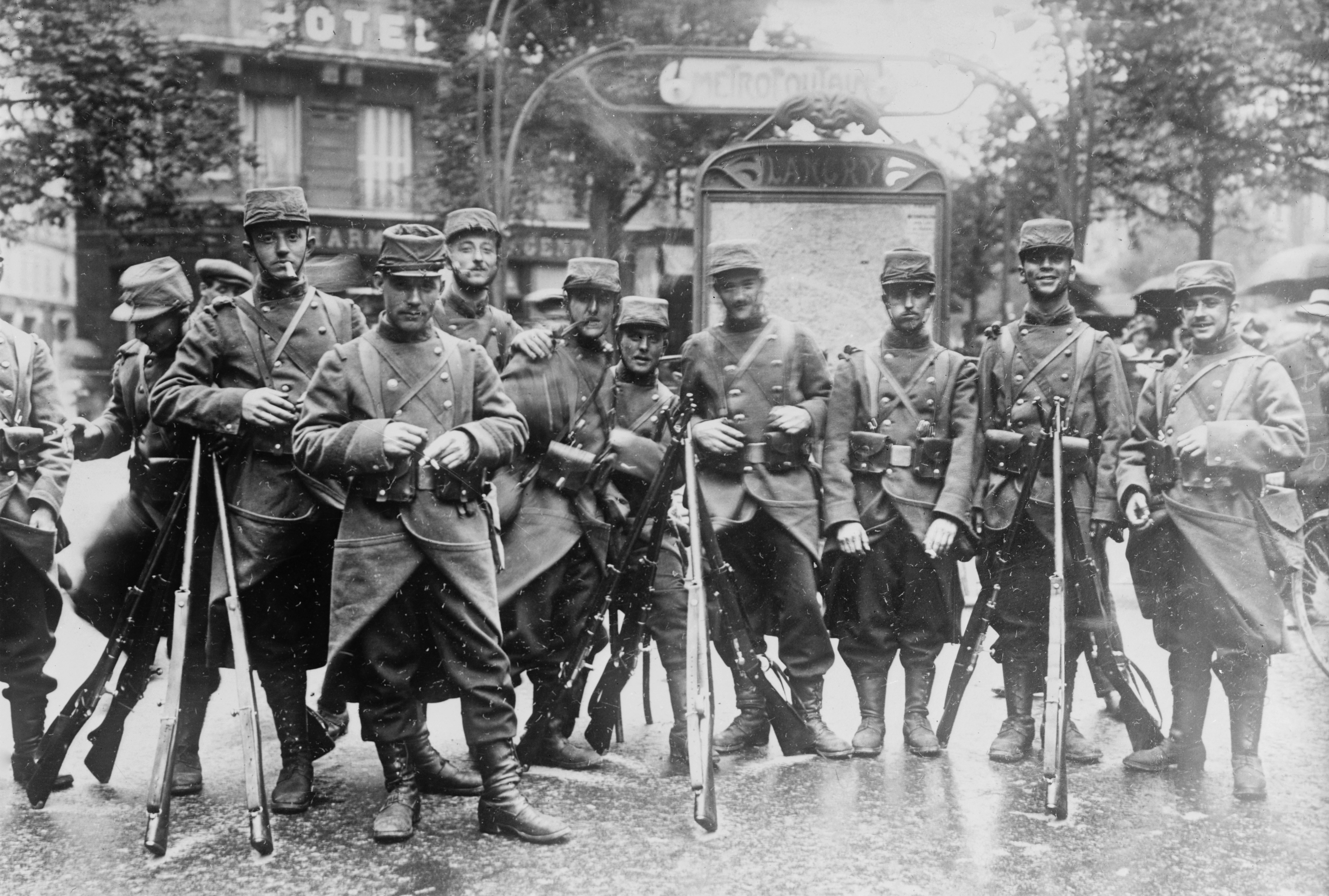
Source: Bain News Service, Public domain, via Wikimedia Commons
D. Source Analysis – European Militarism
Examine the sources on the following pages. Use these sources to draw reasonable conclusions about growing militarism in Europe in the years leading up to 1914.
- What conclusions can we draw from this information about Europe in the years leading up to World War One?
- Which country does not follow the pattern of the others in source A and B? Why do you think that is? What about source D? Does it match the other states in this chart?
- Interpret source C. What is Sir Edward Grey suggesting in this source? What are the implications?
Source A: Triple Entente Peacetime Army Strength (with Index Numbers to show percentage changes) [Source: “Arms Race prior to 1914, Armament policy,” International Encyclopaedia of the First World War. 8 Oct 2014.]
| Year | Britain | France | Russia |
| 1904 | 209.460 = 100 | 575.000 = 100 | 1.100.000=100 |
| 1905 | 213.780 = 102 | 595.000 = 103 | 1.900.000 = 173 |
| 1906 | 196.600 = 93.7 | 590.000 = 99 | 1.000.000 = 90,9 |
| 1907 | 179.209 = 86 | 602.492 = 102 | 1.000.000 = 90,9 |
| 1908 | 183.280 = 88 | 610.923 = 106 | 1.000.000 = 90,9 |
| 1909 | 181.900 = 86.9 | 567.484 = 99 | 1.209.000 = 110 |
| 1910 | 182.350 = 87.1 | 574.342 = 100 | 1.303.000 = 118 |
| 1911 | 182.700 = 87,2 | 593.556 = 103 | 1.345.000 = 122 |
| 1912 | 192.590 = 92 | 611.709 = 106 | 1.332.000 = 121 |
| 1913 | 192.144 = 91,7 | 850.000 = 148 (1914) | 1.300.000 = 118 |
Source B: Triple Alliance and Turkey Peacetime Army Strength (with Index Numbers to show percentage changes) [Source: “Arms Race prior to 1914, Armament policy,” International Encyclopaedia of the First World War. 8 Oct 2014.]
| Years | Germany | Austria-Hungary | Italy | Turkey |
| 1904 | 606.866 = 100 | 361.770 = 100 | 221.085 = 100 | 280.000 = 100 |
| 1905 | 609.552 =100.4 | 361.770 = 100 | 220.834 = 99,9 | |
| 1906 | 614.353 =101,2 | 362.398 = 101 | 249.816 = 113 | |
| 1907 | 616.838 =101,6 | 366.578 = 101 | 249.917 = 113 | |
| 1908 | 619.006 = 102 | 365.742 = 101 | 247.000 = 112 | 361.644 = 129 |
| 1909 | 610.196 =100,5 | 369.203 = 102 | 247.000 = 112 | |
| 1910 | 610.083 =100,5 | 370.510 = 102 | 238.617 = 108 | |
| 1911 | 612.557 =100,9 | 353.017 = 98 | 253.786 = 115 | |
| 1912 | 646.321 =106,5 | 405.120 = 120 | 256.000 = 116 | 378.377 = 135 |
| 1913 | ||||
| 1914 | 811.000 = 137 | 494.000 = 137 | 305.000 = 138 | 250.000 = 89 |
Source C: British Foreign Secretary, Sir Edward Grey, recalling his experience in 1914.
“A great European war under modern conditions would be a catastrophe for which previous wars afforded no precedent. In old days, nations could collect only portions of their men and resources at a time and dribble them out by degrees. Under modern conditions, whole nations could be mobilized at once and their whole lifeblood and resources poured out in a torrent. Instead of a few hundreds of thousands of men meeting each other in war, millions would now meet – and modern weapons would multiply manifold the power of destruction. The financial strain and the expenditure of wealth would be incredible. I thought this must be obvious to everyone else, as it seemed obvious to me. And that if once it became apparent that we were on the edge, all the Great Powers would call a halt and recoil from the abyss.”
Source D: Military expenditures per year of the great powers. Numbers are listed in USD.
M = million (e.g. $286.7M = 286,7000,000 USD)
| NATION | 1908 | 1909 | 1910 | 1911 | 1912 | 1913 |
| Great Britain | $286.7m | $306.2m | $330.4m | $345.1m | $349.9m | $374.2m |
| Germany | $286.7m | $306.8m | $301.5m | $303.9m | $331.5m | $463.6m |
| France | $216m | $236.4m | $248m | $277.9m | $307.8m | $363.8m |
| Russia | $291.6m | $315.5m | $324m | $334.5m | $387m | $435m |
| Italy | $87.5m | $115.8m | $124.9m | $133.7m | $158.4m | $142.2m |
| United States | $189.5m | $199m | $197m | $197m | $227m | $244.6m |
| Japan | $93.7m | $95.7m | $100.2m | $110.7m | $107.7m | $104.6m |
| Source: Jacobson’s World Armament Expenditure, 1935 |
“Preventive war is like committing suicide for fear of death.”
Otto von Bismarck
 CISH Modern History