
Inquiry Question: Why do states increase their military power?
A. Video: The Naval Arms Race
- Why did Kaiser Wilhelm II want a large navy for Germany?
- Why were the British worried about Germany’s construction of warship in the North Sea?
B. Secondary Source: The Anglo-German Naval Arms Race
Read the text below and answer the following questions.
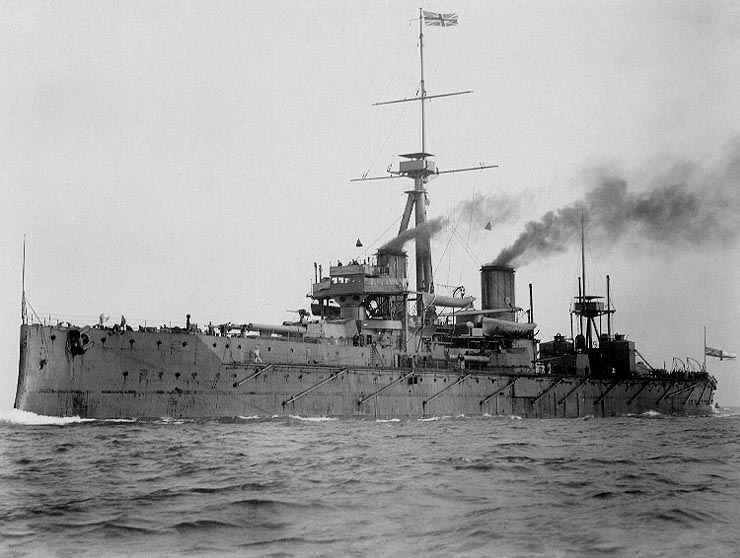
“Britain was, in fact, relatively friendly with Germany for much of the last quarter of the 19th century, not least because Queen Victoria’s eldest daughter was married to the German Crown Prince, Frederick, who succeeded to the imperial throne in March 1888. Frederick died from cancer after reigning for barely three months, and the accession of his estranged and impulsive son, Wilhelm II, heralded fresh competition with Britain for colonies and overseas markets as the new Kaiser sought world power status for Germany. Even so, it was the German Navy Laws of 1898 and 1900 that did most to alienate Britain. Shaped by the German Naval Secretary, Rear Admiral Alfred von Tirpitz, with the Kaiser’s enthusiastic support, these measures disclosed Germany’s intention to construct a fleet, including 38 battleships, within 20 years. Regarding Britain as Germany’s ‘most dangerous naval enemy’, Tirpitz envisaged the German fleet as a political pawn which would strengthen his country’s hand in world affairs. To this end he wished to provide Germany with sufficient capital ships to mount a genuine challenge in the North Sea and give it the capability of inflicting such damage on the Royal Navy that the latter would fall below the ‘Two Power Standard’. The launching of 14 battleships in Germany between 1900 and 1905 inaugurated a naval arms race that would enter an even more menacing phase when Britain launched the revolutionary turbine-driven ‘all-big-gun’ battleship HMS Dreadnought in 1906.”
Adapted from Simkins, Peter, et all. The First World War: The War to End All Wars. Bloomsbury, 2003.
- Why did the Kaiser and Tirpitz want a large navy for Germany? How did this impact Germany’s relationship with Britain?
C. Primary Source: Interview with Kaiser Wilhelm II in the British newspaper The Daily Telegraph (1908).
Interpret the perspectives and the implications of the following primary source.
Questions to consider after reading…
- How would you describe the tone or feeling of the source?
- What is the main idea or message communicated?
- What do you think motivated this person to say what they said?
- What are some possible implications of the source’s perspective?
“You English,” he said, “are mad, mad, mad as March hares. What has come over you that you are so completely given over to suspicions quite unworthy of a great nation? What more can I do than I have done? I declared with all the emphasis at my command, in my speech at Guildhall, that my heart is set upon peace, and that it is one of my dearest wishes to live on the best of terms with England.”
…
“But, you will say, what of the German navy? Surely, that is a [threat] to England. Against who else but England are my squadrons being prepared? If England is not in the minds of those Germans who are bent on creating a powerful fleet, why is Germany asked to consent to such new and heavy burdens of taxation?”
“My answer is clear. Germany is a young and growing empire. She has a worldwide commerce which is rapidly expanding, and to which the legitimate ambition of patriotic Germans refuses to assign any bounds. Germany must have a powerful fleet to protect that commerce and her manifold interests in even the most distant seas. She expects those interests to go on growing, and she must be able to champion them manfully in any quarter of the globe. Her horizons stretch far away.“
– Excerpt from an interview with Kaiser Wilhelm II, published in the British newspaper The Daily Telegraph in 1908.
 CISH Modern History