
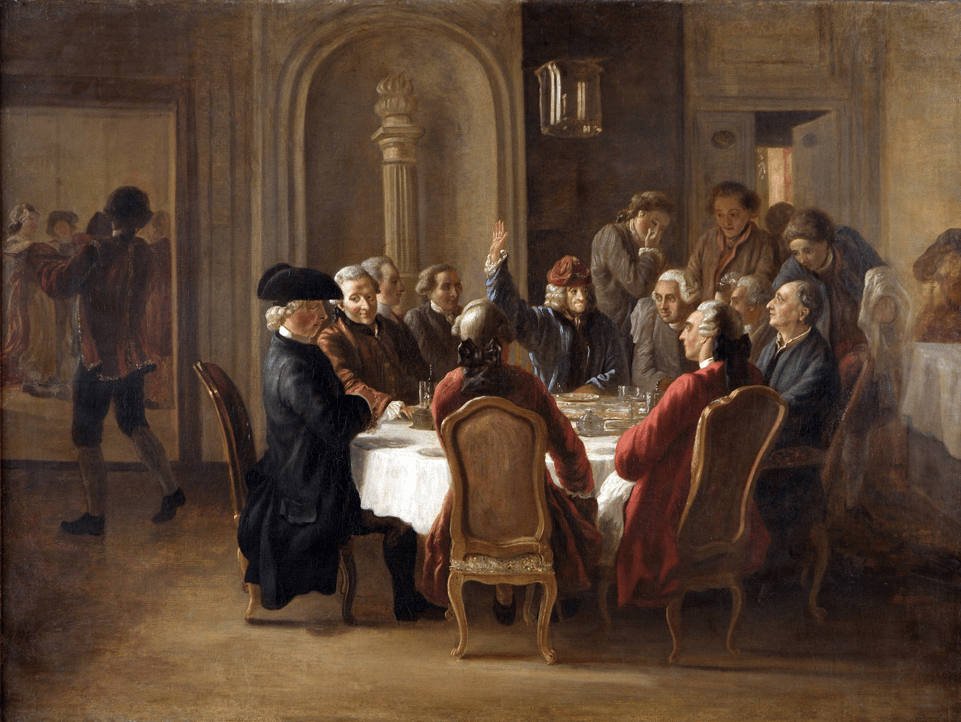
Source: Anicet Charles Gabriel Lemonnier / Public domain
“Enlightenment is man’s emergence from his self-incurred immaturity.”
Emmanual Kant in his essay Answering the Question: What is Enlightenment? published in 1784.
Minds-On: What is wrong with the Divine Right of Kings theory? How could we criticize it?
The Enlightenment was a period of history in Europe in which radical new ideas about society, government, economics, and religion developed by individuals called philosophes or philosophers. Inspired by the scientific revolution that furthered human understanding of the natural world, the philosophes tried to use reasoned thinking to understand social issues. This occurred at a time of increased literacy in Western Europe and books, pamphlets, and newspapers were widely read. Many of the new ideas of the Enlightenment challenged the traditional ideas of social structure, religion and government. In this lesson we will explore some of these new ideas to understand how they contributed to the French Revolution in 1789.
The most important concept that emerged from the Enlightenment was reason. This is the idea that humans can independently understand knowledge, whether it is scientific, political, economic, religious, or social. This is in contrast to tradition where people understand knowledge that was given to them by an authority; e.g. the Church, the government, parents, teachers, society, etc. Enlightenment philosophers believed that they, with reasoned thought, they could discover the “natural laws” governing human affairs.
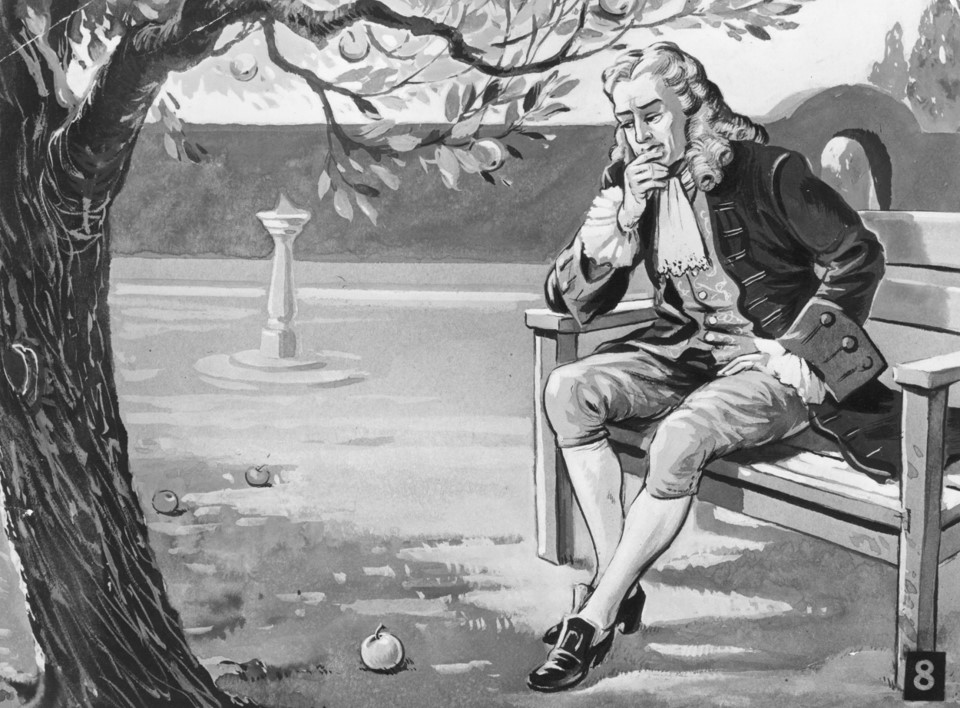
Just as scientific thinkers like Issac Newton, Francis Bacon, and Galileo sought to understand the physical universe through observation and reasoned thought, so too did the philosophes of the Enlightenment seek to understand the natural laws of human societies through similar means (e.g. observation and rational thought).
Viewing Instructions: While you watch the video record some notes on the following topics;
- Some of the ways Europe was being “transformed” (changing) in the 17th and 18th centuries.
- The role of the salon during the Enlightenment
- Some ideas from the following philosophes;
- Montesqieu
- Voltaire
- Rousseau
The French Philosophes
Activity: Interpreting Different Historical Perspectives
Enlightenment Philosophers Primary Sources
- You will begin in home groups. Each of you will join an expert group where you will learn about one Enlightenment philosophe.
- As a group, interpret your philosophe’s views on government.
- Return to your home group and share what you learned about your philosophe. Take notes while you listen to other students speaks.
- Final thought: which of the three philosophes do you think was the most revolutionary?
“In order then that the social [contract] may not be an empty formula, it [implicitly] includes the undertaking, which alone can give force to the rest, that whoever refuses to obey the general will shall be [forced] to do so by the whole body. This means nothing less than that he will be forced to be free; for this is the condition which, by giving each citizen to his country, secures him against all personal dependence. In this lies the key to the working of the political machine; this alone legitimises civil undertakings, which, without it, would be absurd, tyrannical, and liable to the most frightful abuses.”
Jean-Jacques Rousseau in The Social Contract
Further Reading (optional)
Voltaire, Philosophical Dictionary (1764)
Montesquieu, The Spirit of the Laws (1748)
Jean-Jacques Rousseau, Discourse on the Origins of Inequality Among Men (1762)
Hobbes believed that humans in the time of nature were violent and selfish, thus leading to a “state of war”. Locke argued that humans in the time of nature were “free and equal”. Montesqieu, however, argues that humans in the time of nature would feel “inferior” because of a lack of understanding.
In Summary…
The Enlightenment was a period of radical new ideas about government, religion, and society. While the Enlightenment did not cause the French Revolution, it created the ideas that allowed for new forms of government to emerge after 1789. Furthermore, the emphasis on reason and rational thinking, and Rousseau’s concept of the “general will”, led to bloodshed and terror during the radical phase of the Revolution. We will see how one man, Maximilian Robespierre, drenched in the ideas of the Enlightenment sent thousands of French men and women to their deaths in the Place de la Concorde in Paris.
However, the idea of individual liberty, and the equality of all men (equality did not extend to women), were very powerful and would shape the entire course of the Revolution.
Key Terminology
| The Enlightenment | A period of European history where old traditions and ideas were challenged with reason and rational thinking. The Enlightenment was very influential on the American and French Revolutions. |
| Philosophe | A French philosopher. They were often quite popular among the educated nobility and wealthy merchants and businessmen in France. Many philosophes, like Rousseau and Voltaire also wrote poetry, novels, and plays. Many were celebrities in their day and were very famous. |
| Reason | The idea that things can be known and understood with independent thinking. This is the opposite of trusting an authority or memorizing given information. |
| Social contract | An idea of governance discussed by many philosophers, including Hobbes, Locke, and Rousseau. In general, social contract theory states that people must consent to their government. How this looks in real life depended on the philosopher. |
| Salon | The place where Enlightenment ideas were read and discussed, usually over a cup of coffee or tea. Basically the 18th century version of Starbucks. |
| General will | Rousseau’s version of the social contract that government must embody the general will of the people. This means that the government must represent the majority of the people in society, and everyone else must be forced to obey it, so long as everyone is treated equally. |
| Separation of powers | Montesquieu’s theory that no one person or group should have complete political power. Instead, government should be separated into three branches; executive (king), legislative (law-making), and judicial (courts). This is certainly contrary to the concept of absolutism practiced at the time in France. |
 CISH Modern History